
AI Agent Engineer Roadmap: How to Build Production Agents in 2026
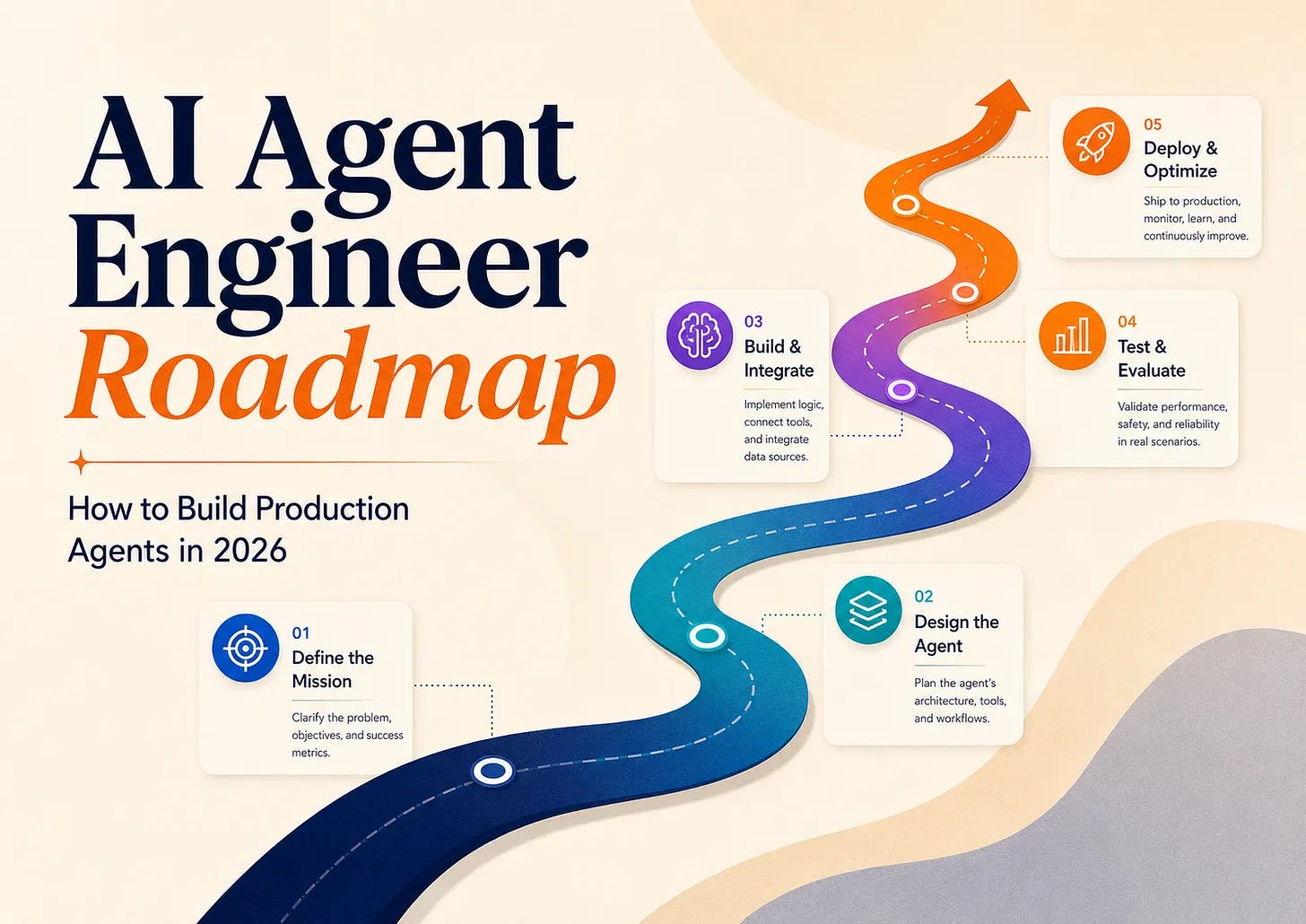
From prompts and tools to MCP, memory, skills, loops, graphs, verification, security, and deployment: a practical 20-step blueprint for building AI agents that actually work in production.

In one experiment, Anthropic gave essentially the same ambitious software-building job to two different agent setups.
The first was a solo agent.
It worked for about 20 minutes.
Cost: roughly $9.
Then Anthropic tried something very different.
Instead of relying on one agent, the second setup used a more elaborate harness with a planner, generator, and evaluator working around the model.
It ran for six hours.
Cost: about $200.
More than 20 times as much.
At first, that sounds wildly inefficient.
Why spend $200 when another agent can attempt the same job for $9?
Because the result was not simply a slightly better answer.
The difference in what the two systems produced was immediately obvious to the researchers.
The longer-running harness was capable of building a much richer, more complete application.
And that experiment exposes one of the most important shifts happening in AI right now.
The model is no longer the whole product.
The engineering around the model is becoming just as important.
For the last few years, people learned how to write better prompts.
Then came retrieval.
Then tool calling.
Then context engineering.
Each layer made AI more capable.
But in 2026, the difficult work is moving somewhere else.
How does an agent know what to do next?
What should it remember?
Which tools should it use?
When should it ask another agent for help?
When should several tasks run at the same time?
How does it recover when something fails?
Who checks whether its work is actually correct?
When should a human take control?
And perhaps the most important question of all:
How do you give an AI system enough autonomy to be useful without giving it so much freedom that it becomes expensive, unpredictable, or unsafe?
That is the emerging job of the AI Agent Engineer.
Inside the Full Roadmap
The complete 20-step build sequence, including model choice, tools, MCP, memory, skills, loops, routing, graphs, parallel agents, verification, checkpoints, human approval, security, observability, evals, cost control, and deployment.
The article also shows what to build first, what to add later, and how these pieces fit together into a production-ready AI agent system.
